Sunday, November 6, 2011

New Project Opposite Jaya One


Projects Details
  •  Size of development: 6.04 acres
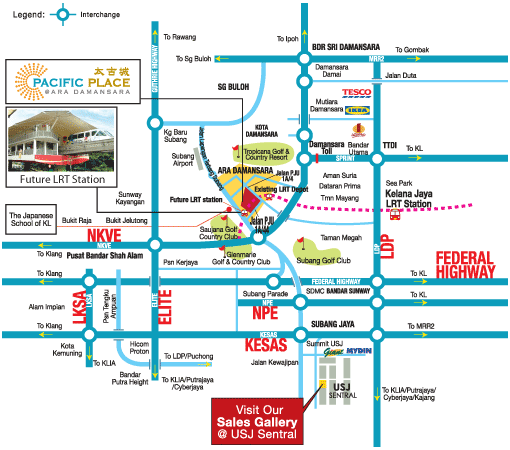
  •  Located at Seksyen 13, Petaling Jaya (opposite Jaya One)
  •  Mixed development of commercial space and residential units.
    - 2 commercial blocks of 14-storeys (Star Office Building) and 17 storeys (Signature Office Suites)
    - 3 service apartment blocks of 25 to 34 storeys
    - 7 storeys of retail space
    - 5 levels of basement car park
    - 3rd to 8th floor elevated car park
  •  Total units of service apartments : 647
  •  Total units of signature office suites : 258
Projects Details
  •  Great location with Asia Jaya LRT Station nearby
  •  Superb accessibility to major highways such as Federal Highway, Sprint Highway, LDP and NKVE, as well as major roads
     close by
  •  Mature surrounding development
  •  Close proximity to established popular shopping centres such as Tropicana City Mall, Mid Valley, SS Two Mall and One
     Utama Mall
  •  Prominent recreational club known as Kuala Lumpur Golf and Country Club
  •  Near to well known hotels such as Hilton, Armada, Crystal Crown and Eastin

Pacific Place


Pacific Place confidently reflects the latest addition of opulence to the already established community that
harbours rich, exclusive amenities surrounding the urban mix development. Welcome to a truly new era of style,
fun and easy living.
  •  Next to New LRT station
  •  Reputable International Schools and Colleges
  •  Luxury Hotels & Golf Resorts
  •  Lifestyle Malls & Hyper Malls (Sunway Pyramid/Carrefour/Subang Parade)
  •  Health Institutions (SJMC & Sunway Medical Centre)
  •  Surrounded by Affluent & Established Communities

EPF Withdrawals


This withdrawal allows you to utilize your savings from Account 2 to partially finance your purchase of a house individually OR jointly with your spouse or close family members namely parents or siblings. Buying of a house with another individual who has no kinship is allowed provided that the other individual is a buyer and borrower. This withdrawal allows you to buy a house from a developer or an individual or through a public auction.
1. What are the requirements for Withdrawal To Purchase A House?
Members must be:
Malaysian citizens; OR
Non-Malaysian citizens who have obtained Permanent Resident (PR) status; OR
Malaysian Citizens who have made Leaving The Country Withdrawal before 1 August 1995 and have opted to re-contribute to the EPF; OR
Non-Malaysian citizens who have became members before 1 August 1998;
2. What is the amount entitlement under Withdrawal To Purchase A House?
Members can withdraw their savings according to the following, whichever is lower;
Individual Purchase – The difference between the house price and the loan amount plus an additional 10% of the house price; OR
All the savings in the applicants’ Account 2 subject to maximum amount eligible for withdrawal (whichever is lower)
Joint Purchase With Spouse, Family Member or Other Individuals
For housing loan of 100% - 10% from the cost of building the house; OR All savings in Account 2 (whichever is lower)
Cash purchase – house price with an additional 10% from the cost of building the house; OR All savings in Account 2 (whichever is lower)
3. How is the payment made?
The payment for withdrawal will be credited directly to the bank account with the following conditions:
- Members own a bank account with the EPF elected panel banks.
- Members’ bank accounts are still active, and
- Members’ bank accounts types are individual savings/current accounts OR Individual Joint Account for withdrawal amount of more than RM100,000.00
4. How do I submit the applications?
Applications can be submitted at any EPF Offices nearby, either at the counters or by post.
For more information, visit the Employees Provident Fund webpage for EPF Withdrawal to Purchase a House.

Home Loans


Just to ensure that you can get the most out of the information for that property you are eyeing, try to get familiar with mortgage terms and talk to some banks on their housing loan promotions. It is important to develop a financial plan so that you not only save money for the down payment, but for other costs that will come along later like the credit check, the mortgage application and the closing.
Listed below is a set of criteria that governs the end-financier’s evaluation of housing loan applications:
Income & Credit
The Applicant should have adequate income to qualify for the loan. The normal requirement is that the monthly loan repayment should not exceed 1/3 of the applicant's monthly income or in the case of joint purchasers, their joint monthly income.
Example: For a RM 200,000.00 loan over a period of 20 years, the monthly loan payment (at 10% per annum x monthly interest) is RM 1958.00. Thus, the applicant must have a minimum monthly income of RM 5,874.00 (RM1,958.00 x 3).
Applicants are required to supply evidence of their income, such as pay slip, EPF statement or income-tax return form to enable the end-financiers to ascertain their ability to repay the loan. However, for those who are self-employed, they should produce bank statements, sales invoices, receipts or other documentary evidence to verify their income claim.
Having an established credit history is also an important criteria in a smooth house buying process. Pay your loan on time, limit your debt, reduce the amount of credit cards you have and use them responsibly. It is also important to reassess your credit report - a record of past and current debt that states when and how you paid.
Age
Generally, the age limit for the loan payment is 55, which corresponds with the normal retirement age. It is possible that some end-financiers might extend the age limit to 60. (Depending on Individual Banks’ Policies or Package)
Guarantor
If your income or credit are not so convincing, the end financier may require you to provide a guarantor or guarantors whose joint income should meet the above mentioned minimum requirement.
Evidence of additional income
To avoid guarantors and you may have a substantial amount in your savings or fixed deposit account you can use it as evidence of additional income which the end-financiers may take into account during evaluation.

Home Buyers Guide


This summary is intended as a general overview of a typical house purchase, and to identify the
typical procedures followed.
Prepare a checklist and go through them one by one before making any decisions.
Below are some pointers that might be able to help you consider before choosing your dream home.
  1. Develop a financial plan that is affordable to your budget and relative to the property
  2. Consider buying a home that you can sell at a profit
  3. What are the pre-requisites that you need for your dream home? List them down
  4. Do not hesitate to call our Sales Advisors who can advise you on your choice of location
    & budget
  5. Visit & compare properties that are on sale/launch. Decide carefully, weigh the pros and cons
    as it will be a long-term commitment
  6. Browse through & study the classified advertisements in the papers for existing properties to
    make comparisons on specifications and market price
Some additional tips that you should take note before making your choice:
  1. Sale and Purchase Agreement (SPA)
  2. Insurance
  3. Stamp duty and Legal Fees on Loan Agreement
  4. Stamp Duty on Transfer
  5. Schedule of Payment
  6. Handing Over of Keys
  7. Certificate of Fitness

Wednesday, October 12, 2011

Steve Jobs Reveals Why He Always Wore the Turtleneck

Steve Jobs reveals why he always wore the black turtleneck in this excerpt from his biography by Walter Isaacson and posted by Gawker.

Jobs is famously recognized for wearing a black long-sleeved mock turtleneck made by St. Croix, Levi's 501 blue jeans, and New Balance 991 sneakers.

----
On a trip to Japan in the early 1980s, Jobs asked Sony's chairman Akio Morita why everyone in the company's factories wore uniforms. He told Jobs that after the war, no one had any clothes, and companies like Sony had to give their workers something to wear each day. Over the years, the uniforms developed their own signatures styles, especially at companies such as Sony, and it became a way of bonding workers to the company. "I decided that I wanted that type of bonding for Apple," Jobs recalled.

Sony, with its appreciation for style, had gotten the famous designer Issey Miyake to create its uniform. It was a jacket made of rip-stop nylon with sleeves that could unzip to make it a vest. So Jobs called Issey Miyake and asked him to design a vest for Apple, Jobs recalled, "I came back with some samples and told everyone it would great if we would all wear these vests. Oh man, did I get booed off the stage. Everybody hated the idea."

In the process, however, he became friends with Miyake and would visit him regularly. He also came to like the idea of having a uniform for himself, both because of its daily convenience (the rationale he claimed) and its ability to convey a signature style. "So I asked Issey to make me some of his black turtlenecks that I liked, and he made me like a hundred of them." Jobs noticed my surprise when he told this story, so he showed them stacked up in the closet. "That's what I wear," he said. "I have enough to last for the rest of my life."
----

Check out Steve's look over the years in the image below...

Read More [via 9to5Mac]

Monday, October 10, 2011

How to Tell if a Diamond is Real

Steps
  1. Ask for a certificate.grading authority (e.g. GIA, AGSL, LGP, PGGL)[1] or an independent appraiser who is affiliated with a professional organization (like the American Society of Appraisers). This is especially important if you're buying a stone you haven't seen, such as from the Internet.
  2. Look through it. Diamonds have a high "refractive index" (meaning they sharply bend the light that passes through them). Glass and quartz have a lower refractive index, meaning they sparkle less because they bend light less, even when they've been cut nicely (because the refractive index is an inherent physical property [2] which is not altered in any way by a nice cut - unless, technically speaking, the cut induced a permanent strain on the crystalline lattice).

    • If the diamond is not mounted, turn it upside down and place it on a piece of newspaper. If you can read the print through the stone or even see distorted black smudges, then it probably isn't a diamond. (Unless the cut is disproportionate, in that case print can be seen through a real diamond.)[3]
    • If the stone shows any sign of double refraction, it may be Moissanite (silicon carbide), a gemstone that is so similar to a diamond that even jewelers can have a hard time telling them apart. Look at the facet junctions from the top side of the stone, the 'star' facets' if you see what looks like double vision then that is the doubling effect.[4]
    • If the diamond is mounted, you should not be able to see the bottom of a diamond looking directly from the top.[5]
    • Draw a small dot with a pen on a piece of white paper. Place your unmounted diamond over the center of the dot. Look directly down on it and if your stone is not a diamond, you will see a circular reflection in the stone.
  3. Observe the reflections. A real diamond's reflections usually manifest in various shades of gray. If you see rainbow reflections, you're either dealing with a low-quality diamond or a fake.[6]
  4. Take the bottom view: Under a microscope hold the stone table (top facet) down. If you see an orange flash only to the facets as you rock the stone it is fake.[7]
  5. Buy a combination Diamond/Moissanite Tester. These are readily available and can quickly indicate if it is a true diamond or simulant.[8]
  6. Weigh the stone. Cubic zirconia weighs approximately 55% more than diamonds for the same shape and size.[9] Use a carat or gram scale to compare the stone in question to a real diamond.
  7. Check the setting and mount. A real diamond is not likely to be set in a cheap metal.[10] Stamps inside the setting indicating real gold or platinum (10K, 14K, 18K, 585, 750, 900, 950, PT, Plat) are a good sign, while a "C.Z." stamp will give away that the center stone is not a real diamond.[11]
  8. Put the stone under a UV light. Many (but not all) diamonds will exhibit blue fluorescence under an ultra violet or black light, so the presence of a medium to strong blue confirms that it is real. The absence of blue, however, does not mean it is fake; it could simply be a better quality diamond.[12] If you see a very slight green, yellow, or gray fluorescence under ultraviolet light, it may be Moissanite.[13]
  9. Test it with a heat probe. Real stones disperse heat quickly and they won't heat up with the probe. This takes about 30 seconds and is often done free of charge. It also doesn't hurt the stone the way some other ways of testing will.
  10. Use the fog test: Put the stone in front of your mouth and fog it like you would a mirror. If it stays fogged for a couple seconds, it’s probably a fake. A real diamond disperses the heat instantaneously so by the time you look at it, it has already cleared up, or if it happens to be a little dirty, it still clears much faster than a fake. Use a stone you know is real next to the suspect stone and fog both. You can watch how the real one stays clear while the fake one fogs over, plus if you breath on them repeatedly, you will see condensation start to build up on the fake, it fogs more with with each puff, while the real one is still clean and clear.
  11. Have the diamond x-rayed. Real diamonds do not show up on an x-ray, glass, cubic zirconium and crystals all have slightly radiopaque quailities, diamonds are radiolucent.

Thailand Reinforces Flood Defenses as Bangkok Under Threat

By Suttinee Yuvejwattana and Supunnabul Suwannakij
(Adds comment from Bangkok governor in seventh paragraph.)
Oct. 10 (Bloomberg) -- Thai officials rushed to reinforce barriers and widen canals in the capital Bangkok on concern the nation’s worst floods in more than half a century may spread to the capital later this week.
The deluge swept across the country starting in late July, killing 269 people, swamping factories operated by Honda Motor Co., Nikon Corp. and Canon Inc. and damaging more than 10 percent of rice farms in the biggest exporter of the grain.
Prime Minister Yingluck Shinawatra opened army camps to help house some of the 2.4 million people displaced by the floods, and asked authorities to accelerate efforts to protect the capital. The finance ministry today cut its forecast for economic growth to 3.7 percent from 4 percent and said the disaster may cause 120 billion baht ($3.9 billion) of damage.
“It’s difficult to estimate the water volume, but if we can protect the flood barriers in three key points in the next one to two days, Bangkok should be saved,” Yingluck told reporters at Bangkok’s former international airport, which has been turned into the country’s main flood-management center.
The situation is “quite worrisome,” Bank of Thailand Governor Prasarn Trairatvorakul said, adding that agricultural industry losses may total as much as 20 billion baht.
In Bangkok, officials are rushing to build three additional flood barriers and plan to dig five more canals over the next seven days to drain water from the capital, Yingluck said.
Evacuation Plans
Oct. 16 through Oct. 18 is the highest risk period for Bangkok, with low-lying areas near Suvarnabhumi airport and communities next to the river and canals the most vulnerable, the city’s Governor Sukhumbhand Paribatra said today by phone. Officials are shoring up flood walls, preparing evacuation plans and readying medical supplies, he said.
Some supermarkets in the capital reported shortages because of delivery disruptions and panic buying, said Saofang Ekaluckrujee, senior corporate affairs manager at Ek-Chai Distribution System Co., which operates Tesco Lotus hypermarkets in Thailand.
“There was panic buying of dry groceries such as instant noodles and rice at most of our stores in Bangkok,” Saofang said by phone. “In some stores, there were shortages of dry food because the flooding has affected logistics. We are trying everything to secure supplies to meet demand.”
‘Just Temporary’
Thailand’s government will provide as much as 200,000 metric tons of rice from its stockpiles and asked local producers of instant noodles, canned food and water to increase production to prevent shortages, Permanent Secretary for Commerce Yanyong Phuangrach told reporters yesterday.
“The situation is nowhere near crisis proportion just yet where food and water are concerned," said Sukhumbhand, the Bangkok governor. ‘‘Major arteries to transport all these things to Bangkok are still open, so I hope it’s just temporary.’’
North of Bangkok, authorities evacuated residents in the central province of Nakhon Sawan after a flood barrier was breached on the Chao Phraya river, said Wim Rungwattanajinda, a spokesman for the national flood center. As many as 650 patients are being evacuated from the province’s main hospital, Health Minister Wittaya Buranasiri told reporters today.
In Ayutthaya, 67 kilometers (42 miles) north of Bangkok, rising floodwaters broke through defenses around the Rojana Industrial Park, which is mostly a base for companies making automotive and electronics parts. The 198 plants have a combined investment value of 56 billion baht, and a total workforce of 90,000, said Suparp Kleekhajai, the vice industry minister.
Honda, Hana
Hundreds of Honda cars were damaged when dikes failed at the Rojana park, where the company produces as many 240,000 vehicles a year, said Pitak Pruittisarikorn, executive vice president of Honda’s Thai unit.
‘‘We will try to resume production at the plant as soon as we can, but we have to wait until the water situation is under control,” Pitak told reporters. “The water level hasn’t peaked yet. It’s still rising.” Pitak said the company is insured against flood damage.
Flood barriers are still protecting the Hi-Tech and Bang Pa-In industrial estates in Ayutthaya, Suparp said.
Hana Microelectronics Pcl, Thailand’s biggest semiconductor packager, said it may take 20 days to reinstall equipment even if the Hi-Tech facility escapes the flood.
Seasonal storms have affected more than 6 million people in Southeast Asia and claimed a further 224 lives in Cambodia, Vietnam and the Philippines, the United Nations said last week. Monsoons across Asia last month generated about $7 billion of losses, including $1.1 billion in Thailand, Aon Benfield, a reinsurer, said in a report on Oct. 5.
The deluge has affected 8.2 million people in Thailand since July 25, data from the Department of Disaster Prevention and Mitigation show.
“There is no need to declare Bangkok a disaster zone yet because we can still control the situation,” Yingluck said today. “But we may need to assess the situation again when the new storm arrives.”
--With assistance from Daniel Ten Kate, Yumi Teso and Anuchit Nguyen in Bangkok. Editors: Tony Jordan, Sunil Jagtiani
To contact the reporters on this story: Suttinee Yuvejwattana in Bangkok at suttinee1@bloomberg.net; Supunnabul Suwannakij in Bangkok at ssuwannakij@bloomberg.net
To contact the editor responsible for this story: Tony Jordan at tjordan3@bloomberg.net

Malaysia Budget 2012 highlights

Monday, October 10, 2011

KUALA LUMPUR, Malaysia - Highlights of Budget 2012 tabled by Prime Minister Datuk Seri Najib Tun Razak in Parliament Friday.

- Last year our FDI growth was the strongest in Asia and in the first 6 months of this year have already reached RM21.2bil (S$8.7 billion)

- In 2012, private investment is forecast to climb 15.9%, supported by foreign and domestic investment

- GDP in the first 6 months of 2011 was 4.4%, driven by strong domestic consumption

- In 2011, the economy is forecast to grow by 5-5.5%

- Private and public investment are forecast to increase by 15.9% and 7%, supported by foreign investment, the ETP and 10MP

- In 2012, the service sector is expected to grow 6.5%, the construction sector 7% and GDP is forecast to be between 5 and 6%

- Budget 2012 allocates RM232.8bil for Government plans, including RM181.6bil for management and RM51.2bil for development

- RM29.8bil has been allocated for investment in infrastructure, industrial and rural development

- RM13.6bil has been allocated for the social sector, including education and training, welfare, housing and community development

- Total revenue for 2012 is forecast to increase 1.9% to RM186.9bil and the deficit to decrease to 4.7% of GDP from 5.4% in 2011

- The theme for Budget 2012 is “National Transformation Policy: Welfare for the Rakyat, Well-Being of the Nation”

- We will focus on accelerating investment and further liberalise 17 services sub-sectors, in places enabling 100% foreign equity.

- RP2 will be implemented in 2012, and it will be allocated RM98.4bil, to be split evenly between 2012 & 2013

- RP2 main projects will include the East Coast Highway from Jabor to T'ganu and road upgrades from Kota Marudu to Ranau

- RM18bil of the RM20bil PPP Facilitation Fund will be used for high impact projects, with RM2 billion for bumiputera entrepreneurs

- In 2012, the Government will allocate RM978mil to accelerate the development in five regional corridors

- The Treasury Management Centre will be established and offer incentives to develop M'sia as a competitive financial centre

- We will develop the Kuala Lumpur International Financial District, with incentives including income tax exemptions for firms

- We will develop the Kuala Lumpur International Financial District, with incentives including income tax exemptions for firms

- Income tax exemptions for non-ringgit sukuk issuance and transactions will be extended for another 3 years

- To promote the development of Exchange Traded Funds products I-VCAP will provide RM200mil for Shariah-compliant ETFs

- Felda GVH will be listed on Bursa Malaysia by mid-2012 to raise funds for the company to become a global conglomerate. Felda settlers are expected to receive a windfall, and the amount will be announced before listing

- A RM2bil shariah-compliant SME Financing Fund managed by selected Islamic banks will be established in 2012

- A RM100mil SME Revitalisation Fund offering loans up to a maximum of RM1mil for entrepreneurs will be available from Jan 2012

- Full exemption of import duty and excise duty on hybrid cars and electric cars will continue to be given until 2013

- To promote tourism, the Langkawi Five Year Tourism Development Master Plan will be launched with an allocation of RM420mil

- The real property gains tax will be reviewed so it doesn't jeopardise the ability of low- and middle-income groups to buy homes

- The Malaysia Healthcare Travel Council will be privatised to promote and develop Malaysia as a healthcare destination

- Budget focuses on developing human capital, creativity and innovation and 2012 will be the National Innovation Movement year

- The Govt has allocated RM100mil promote innovation including the 1Malaysia Award (C1PTA) for innovative student inventions

- To enable SMEs to commercialise research products a Commercialisation Innovation Fund totalling RM500mil will be established

- RM50.2bil will be allocated to the education sector so that it can continue to develop talented, creative and innovative people

- RM1bil will be provided through a special fund for the construction, improvement and maintenance of schools

- We will abolish payments for primary and secondary education, making these free for the first time in our history

- Private schools registered with the Education Ministry will be given incentives including an Investment Tax Allowance

- The Govt will give tax exemption for contributions to educational institutions and all places of worship

- To encourage private sector human capital development incentives including a double deduction on scholarships will be offered

- Budget 2012 introduces a Rural Transformation Programme, so that rural areas can attract private investment and create employment

- RM5bil to develop rural infrastructure, including RM1.8bil to the Rural Road Programme & Village-Link Road Project

- RM500mil to expand the programme to supply clean water to the rural community in Sabah

- RM400mil to upgrade the water supply infrastructure in selected Felda areas - To provide greater access to bank services for the rural population, Bank Simpanan Nasional will appoint agents in rural areas

- RM90mil for the Orang Asli for basic necessities, including the expansion of the clean water supply project. For the Orang Asli affected by the landslides at Sungai Ruil, RM20mil is provided for their relocation to new homes

- 600,000 Govt pensioners will benefit from an additional annual pension increment of 2%

- Civil servants get pay rise between RM80 to RM320

- Govt will extend the compulsory retirement age from 58 to 60 years old to optimise civil servants' contribution

- Civil servants will be offered tuition fee assistance for part-time studies, including 5,000 masters and 500 doctoral scholarships

- A special programme will be introduced for 175,000 army personnel who are not eligible for pensions

- RM3,000 will be given to ex-members of the special constable and auxiliary police as well as widows and widowers

- The Govt is mindful of the plight of the rakyat due to rising food prices and will take measures to address this

- The National Agro-Food Policy 2011-2020 will be launched and RM1.1bil allocated for the development of the agriculture sector

- In the spirit of “People First,” all subsidies, incentives and assistance totalling RM33.2bil will be continued

- 500,000 will benefit from KAR1SMA, which provides assistance to poor senior citizens and children and disabled people

- My First Home Scheme will be expanded to increase the limit of house prices from a maximum of RM220,000 to RM400,000

- Govt will identify areas in the vicinity of MRT, LRT and other public transport to be developed by PR1MA

- Govt will continue to implement the Program Perumahan Rakyat by building 75,000 units of affordable houses

- Govt will establish the Special Housing Fund for Fishermen to build and refurbish houses

- Healthcare will be allocated RM15bil operating expenditure and RM1.8bil development expenditure

- Hospitals will be upgraded and constructed as well 81 rural health clinics upgraded and 50 new 1Malaysia clinics launched

- Hospital Kuala Lumpur - the oldest in Malaysia - will be upgraded to be the country's premier hospital

- Skim Amanah Rakyat (SARA) 1Malaysia will benefit 100,000 households with income below RM3,000 per month

- To assist taxi owners facing increased operating costs, measures will be introduced including tax exemptions on taxi purchases
- The National Legal Aid Foundation will ensure that every individual who is charged in court will be given free legal aid

- To assist the homeless, the Govt established a social assistance centre known as Anjung Singgah

- A training allocation of RM10mil will be provided for women to develop leadership and managerial skills

- To prevent cervical cancer, the Government will provide free Human Papilloma Virus immunisation nationwide

- MyCreative Venture Capital with an initial fund of RM200mil to be established - RM15mil will be allocated to build 150 futsal courts to achieve the “One Court for One Mukim” target

- To ensure the welfare of retirees measures including a tax relief on Private Retirement Schemes contributions are introduced - Senior citizens aged 60 years & above will be exempted from outpatient registration fees in Govt hospitals & health clinics

- One-off assistance of RM500 to households with a monthly income of RM3,000 and below will be provided - For those in private sector earning RM5000 and below, employers' EPF contribution will increase from 12% to 13%

- Book voucher worth RM200 will be given to Malaysian students in all private and public institutions of higher learning

- Civil servants will be given an additional bonus of half-month salary and pensioners RM500

Source:Asia One News

Thursday, October 6, 2011

Malaysian Budget 2012


Najib Checks On Final 2012 Budget Preparations
PUTRAJAYA, Oct 6 (Bernama) -- Prime Minister Datuk Seri Najib Tun Razak Thursday night monitored final preparations involving Finance Ministry's staff ahead of tomorrow's tabling of the 2012 Budget.

Najib, who is Finance Minister, spent about one hour at the ministry, during which he also chaired a closed-door meeting with senior ministry officials.

Present were his wife, Datin Seri Rosmah Mansor, Second Finance Minister Datuk Seri Ahmad Husni Hanadzlah, Deputy Finance Ministers Datuk Dr Awang Adek Hussin and Datuk Donald Lim Siang Chai.

Treasury Secretary-General Tan Sri Dr Wan Abdul Aziz Wan Abdullah, Chief Secretary to the Government Tan Sri Mohd Sidek Hassan as well as Bank Negara Governor Tan Sri Dr Zeti Akhtar Aziz were also present.

Najib is scheduled to table Malaysia's 2012 Budget at the Dewan Rakyat at 4pm.

In remarks made ahead of the event, the prime minister said that it would be a transformational budget for all Malaysians in line with the concept of 1Malaysia: People First, Performance Now.

-- BERNAMA

Contributors